Rules & How to Play

Rules & How to Play

Explore the ruling and mechanics of Tacenda.

Explore the ruling and mechanics of Tacenda.

Introduction

Introduction

You are a celestial commander sent from Constellation Atlas, you’ve been sent to Earth to untangle conflicts between factions of the flipped world Tacenda. Your jobs is to command walkers and Guardians to take down your opposing Factions and take back Earth from the corruption of the reflection.

You are a celestial commander sent from Constellation Atlas, you’ve been sent to Earth to untangle conflicts between factions of the flipped world Tacenda. Your jobs is to command walkers and Guardians to take down your opposing Factions and take back Earth from the corruption of the reflection.

Game Setup

Game Setup

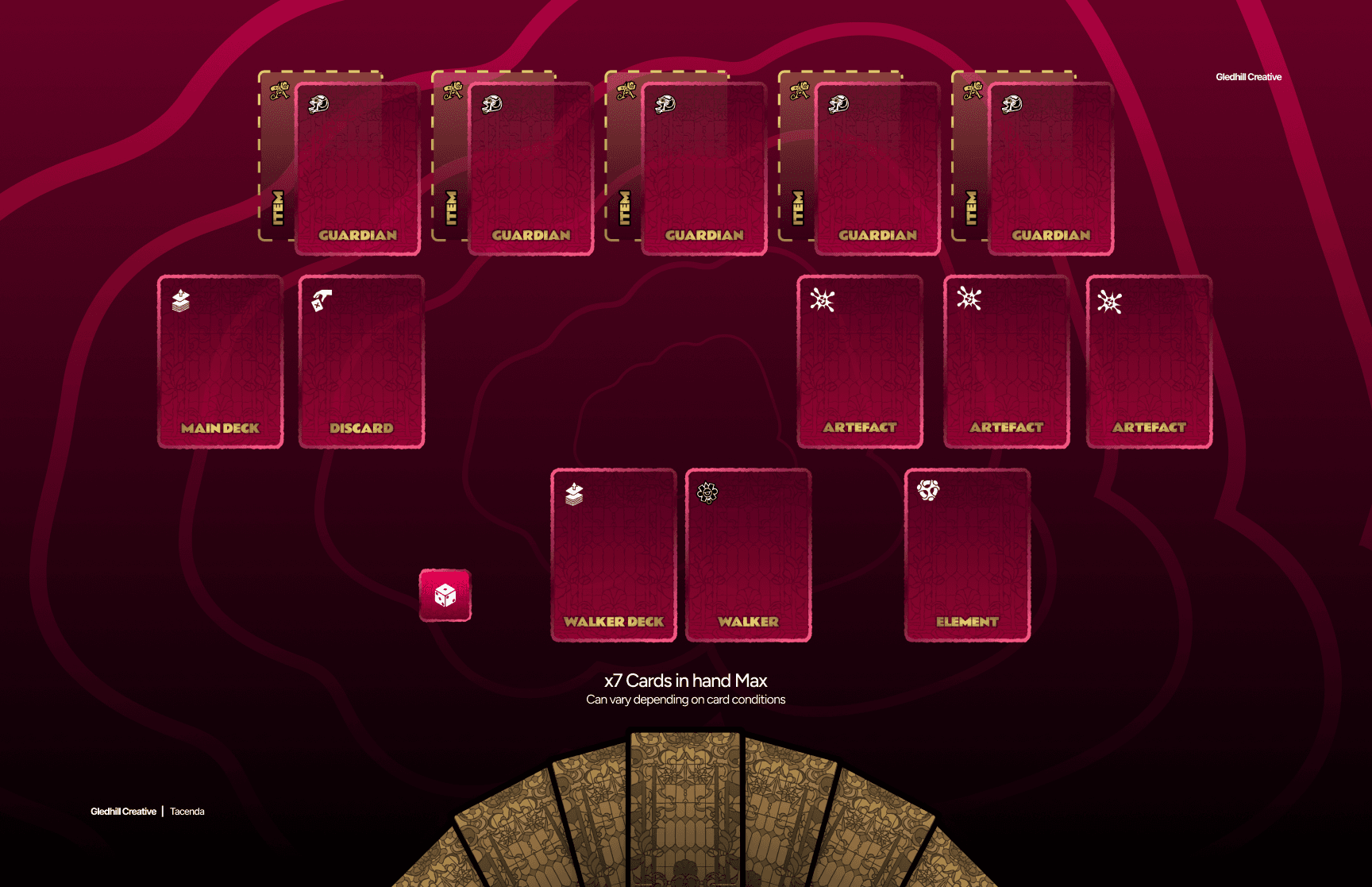
Each player shuffles their 42 card deck and places it face down on their side of the battlefield.


Players then take their five Walker cards and arrange them face down in a single stack, ordered from Level 1 at the top to Level 5 at the bottom.

This order must not be changed during the game.


Each player then reveals their Level 1 Walker and places it face up in the Walker position on the battlefield.


Determining the Starting Player


Both players roll a six sided die to determine who begins the game.


The player who rolls the highest number takes the first turn.


Starting Hands


Each player draws the top five cards from their deck to form their starting hand.


If a player’s starting hand does not contain a Guardian, they must shuffle their hand back into the deck and draw a new hand of five cards. This process is repeated until the player has at least one Guardian in their starting hand.


Each player shuffles their 42 card deck and places it face down on their side of the battlefield.


Players then take their five Walker cards and arrange them face down in a single stack, ordered from Level 1 at the top to Level 5 at the bottom.

This order must not be changed during the game.


Each player then reveals their Level 1 Walker and places it face up in the Walker position on the battlefield.


Determining the Starting Player


Both players roll a six sided die to determine who begins the game.


The player who rolls the highest number takes the first turn.


Starting Hands


Each player draws the top five cards from their deck to form their starting hand.


If a player’s starting hand does not contain a Guardian, they must shuffle their hand back into the deck and draw a new hand of five cards. This process is repeated until the player has at least one Guardian in their starting hand.


Starting the Game

Starting the Game

At the start of their turn, the active player rolls one six sided die.


The number rolled is added to the level of their current Walker. This combined value represents the maximum total level of cards the player may play during that turn.


Example


If a player rolls a 5 and their current Walker is Level 3, their total for that turn is 8.


The player may play cards from their hand whose combined levels are equal to or lower than this total.


Playing Cards


Players may play a maximum of three cards per turn.


All cards played must be placed face up in their correct positions on the battlefield, unless a card effect specifically states otherwise.

At the start of their turn, the active player rolls one six sided die.


The number rolled is added to the level of their current Walker. This combined value represents the maximum total level of cards the player may play during that turn.


Example


If a player rolls a 5 and their current Walker is Level 3, their total for that turn is 8.


The player may play cards from their hand whose combined levels are equal to or lower than this total.


Playing Cards


Players may play a maximum of three cards per turn.


All cards played must be placed face up in their correct positions on the battlefield, unless a card effect specifically states otherwise.

Guardians and Attacking

Guardians and Attacking

Guardians are used to defend your Walker and to attack opposing Guardians on the battlefield.


The starting player may not attack during their first turn. This ensures that both players have the opportunity to place Guardians onto the battlefield before combat begins.


Combat may begin once both players have at least one Guardian in play.


Declaring an Attack


To initiate combat, the active player chooses one of their Guardians and declares which opposing Guardian it will attack.


Each Guardian may attack only once per round, unless a card ability states otherwise.


Resolving Combat


When an attack is declared, compare the power values of the attacking and defending Guardians.


• If the attacking Guardian’s power is higher than the defending Guardian’s power, the defending Guardian is defeated and removed from the battlefield.

• If the attacking Guardian’s power is lower than the defending Guardian’s power, the defending Guardian remains in play.
• If the attacking Guardian’s power is equal to the defending Guardian’s power, the defending Guardian and the attacking guardian are then both destroyed.


Combat Restrictions


Only one Guardian may attack a single enemy Guardian.

• Players cannot combine multiple Guardians to defeat one opposing Guardian. Unless a card says otherwise.

Guardians are used to defend your Walker and to attack opposing Guardians on the battlefield.


The starting player may not attack during their first turn. This ensures that both players have the opportunity to place Guardians onto the battlefield before combat begins.


Combat may begin once both players have at least one Guardian in play.


Declaring an Attack


To initiate combat, the active player chooses one of their Guardians and declares which opposing Guardian it will attack.


Each Guardian may attack only once per round, unless a card ability states otherwise.


Resolving Combat


When an attack is declared, compare the power values of the attacking and defending Guardians.


• If the attacking Guardian’s power is higher than the defending Guardian’s power, the defending Guardian is defeated and removed from the battlefield.

• If the attacking Guardian’s power is lower than the defending Guardian’s power, the defending Guardian remains in play.
• If the attacking Guardian’s power is equal to the defending Guardian’s power, the defending Guardian and the attacking guardian are then both destroyed.


Combat Restrictions


Only one Guardian may attack a single enemy Guardian.

• Players cannot combine multiple Guardians to defeat one opposing Guardian. Unless a card says otherwise.

Attacking Walkers

Attacking Walkers

A Walker may only be attacked if its controlling player has no Guardians in play.


If one or more Guardians are present on that player’s battlefield, they must be defeated before the Walker can be targeted.


Declaring an Attack


When attacking a Walker, the attacking player may choose one or more of their Guardians to participate in the attack.


The combined power of all attacking Guardians must be greater than the Walker’s power in order to defeat it.


If the total power of the attacking Guardians is equal to or lower than the Walker’s power, the attack fails and the Walker remains in play.


Attack Commitment


Any Guardian used to attack a Walker is considered to have performed an attack during that round.


A Guardian that has attacked cannot attack again during the same round, unless a card ability states otherwise.

A Walker may only be attacked if its controlling player has no Guardians in play.


If one or more Guardians are present on that player’s battlefield, they must be defeated before the Walker can be targeted.


Declaring an Attack


When attacking a Walker, the attacking player may choose one or more of their Guardians to participate in the attack.


The combined power of all attacking Guardians must be greater than the Walker’s power in order to defeat it.


If the total power of the attacking Guardians is equal to or lower than the Walker’s power, the attack fails and the Walker remains in play.


Attack Commitment


Any Guardian used to attack a Walker is considered to have performed an attack during that round.


A Guardian that has attacked cannot attack again during the same round, unless a card ability states otherwise.

Walker Progression

Walker Progression

When a Walker is defeated, it is immediately removed from play and placed at the bottom of the Walker deck.


The player must then reveal the next Walker from their Walker deck and place it onto the battlefield immediately.


Artefacts and Attached Cards


When a Walker is eliminated, any Artefact cards or other cards attached to that Walker are also removed from the battlefield and placed in the discard pile, unless a card effect states otherwise.


Walker Levels


Each new Walker that enters play must be one level higher than the previous Walker.


This means players progress through their Walkers in ascending level order throughout the game.


Player Elimination


If a player has no Walkers remaining when their current Walker is defeated, that player is eliminated from the game.

When a Walker is defeated, it is immediately removed from play and placed at the bottom of the Walker deck.


The player must then reveal the next Walker from their Walker deck and place it onto the battlefield immediately.


Artefacts and Attached Cards


When a Walker is eliminated, any Artefact cards or other cards attached to that Walker are also removed from the battlefield and placed in the discard pile, unless a card effect states otherwise.


Walker Levels


Each new Walker that enters play must be one level higher than the previous Walker.


This means players progress through their Walkers in ascending level order throughout the game.


Player Elimination


If a player has no Walkers remaining when their current Walker is defeated, that player is eliminated from the game.

Gameplay Effects

Gameplay Effects

Most cards in Tacenda contain abilities that activate when the card is played or when a specific condition is met.


Many abilities are written as On Effect abilities. This means the ability is triggered immediately when the action described on the card is carried out. Such as:

Play: Once you play the card
Death: Once that card is destroyed
Kill: Once that card destroys another enemy guardian/walker
Trigger: Upon the abilities trigger effect.
Each Turn: Every turn whilst in play
Action: When the action is met from the ability


In most cases, the card text clearly explains the effect and provides all the information required to resolve the ability.


However, some cards include keyword effects that represent common mechanics used throughout the game.


Stunned


Stunned is a keyword effect that temporarily disables a card.


When a card becomes Stunned, rotate the card 90 degrees clockwise for each round it remains stunned.


Examples:

Stunned for 1 round – rotate the card 90 degrees.

Stunned for 2 rounds – rotate the card 180 degrees.


At the end of each round, rotate the card 90 degrees back towards its normal position until it returns to its upright state.


Effects of Stun


While a card is Stunned:


• It cannot attack.

• It cannot use its abilities.


However, a Stunned Guardian may still defend its Walker if required. Meaning it can still be attacked by an opposing guardian.


Once the card returns to its upright position, the stun effect ends and the card functions normally again.

Most cards in Tacenda contain abilities that activate when the card is played or when a specific condition is met.


Many abilities are written as On Effect abilities. This means the ability is triggered immediately when the action described on the card is carried out. Such as:

Play: Once you play the card
Death: Once that card is destroyed
Kill: Once that card destroys another enemy guardian/walker
Trigger: Upon the abilities trigger effect.
Each Turn: Every turn whilst in play
Action: When the action is met from the ability


In most cases, the card text clearly explains the effect and provides all the information required to resolve the ability.


However, some cards include keyword effects that represent common mechanics used throughout the game.


Stunned


Stunned is a keyword effect that temporarily disables a card.


When a card becomes Stunned, rotate the card 90 degrees clockwise for each round it remains stunned.


Examples:

Stunned for 1 round – rotate the card 90 degrees.

Stunned for 2 rounds – rotate the card 180 degrees.


At the end of each round, rotate the card 90 degrees back towards its normal position until it returns to its upright state.


Effects of Stun


While a card is Stunned:


• It cannot attack.

• It cannot use its abilities.


However, a Stunned Guardian may still defend its Walker if required. Meaning it can still be attacked by an opposing guardian.


Once the card returns to its upright position, the stun effect ends and the card functions normally again.

Dice Rolls

Dice Rolls

In Tacenda, the die is one of the most important components in the game. At the start of each turn, players roll the die to determine their cost total for that round. This cost total determines which cards can be played during the turn. The die may also interact with certain abilities used by Guardians and Walkers.


However, rolling a low number can place a player at a disadvantage, particularly when an opponent rolls consistently high numbers and has already established a strong presence on the battlefield while your Walker remains unprotected.


The Bank


To help balance this randomness, Tacenda introduces The Bank.


If you roll a high number and do not spend your entire cost total during your turn, any unused cost points may be banked for use in a future turn.


For example:

If you roll a 6 and spend only 4 cost points, the remaining 2 points may be placed in the Bank.

On a later turn, if you roll a low number, you may add the 2 banked points to your roll, giving you a total cost of 4 for that turn. You may then play cards costing up to 4 in total.


Bank Limits


The Bank is subject to the following rules:


• The maximum number of banked cost points is 6.

• Banked points may be used in any amount during a turn.

• Any points used are deducted from the Bank total.


Tracking Banked Points


Banked points must be tracked using a spare die placed in the Die Bank area of your playmat.


This die should not be the same die used for rolling at the start of each turn.

In Tacenda, the die is one of the most important components in the game. At the start of each turn, players roll the die to determine their cost total for that round. This cost total determines which cards can be played during the turn. The die may also interact with certain abilities used by Guardians and Walkers.


However, rolling a low number can place a player at a disadvantage, particularly when an opponent rolls consistently high numbers and has already established a strong presence on the battlefield while your Walker remains unprotected.


The Bank


To help balance this randomness, Tacenda introduces The Bank.


If you roll a high number and do not spend your entire cost total during your turn, any unused cost points may be banked for use in a future turn.


For example:

If you roll a 6 and spend only 4 cost points, the remaining 2 points may be placed in the Bank.

On a later turn, if you roll a low number, you may add the 2 banked points to your roll, giving you a total cost of 4 for that turn. You may then play cards costing up to 4 in total.


Bank Limits


The Bank is subject to the following rules:


• The maximum number of banked cost points is 6.

• Banked points may be used in any amount during a turn.

• Any points used are deducted from the Bank total.


Tracking Banked Points


Banked points must be tracked using a spare die placed in the Die Bank area of your playmat.


This die should not be the same die used for rolling at the start of each turn.
Winning the Game

Winning the Game


Winning the Game


In Tacenda, the game is won by eliminating all of your opponent’s Walkers.


Each time a Walker is defeated, it is removed from play and replaced by the next Walker in that player’s Walker stack. Players continue progressing through their Walkers in ascending level order, from Level 1 to Level 5.


A player loses the game immediately if their current Walker is defeated and they have no remaining Walkers available to place onto the battlefield.


Running Out of Cards


If a player attempts to draw a card but their deck is empty, the game continues, but the player suffers a penalty.


If a player’s deck is completely empty, they must reshuffle their discard pile to form a new deck.


When doing so, the player must immediately discard one of their Walkers. Walkers are discarded in descending order of level, beginning with Level 5 and proceeding downwards if necessary.


This rule applies every time a player’s deck is depleted.


Winning the Game


In Tacenda, the game is won by eliminating all of your opponent’s Walkers.


Each time a Walker is defeated, it is removed from play and replaced by the next Walker in that player’s Walker stack. Players continue progressing through their Walkers in ascending level order, from Level 1 to Level 5.


A player loses the game immediately if their current Walker is defeated and they have no remaining Walkers available to place onto the battlefield.


Running Out of Cards


If a player attempts to draw a card but their deck is empty, the game continues, but the player suffers a penalty.


If a player’s deck is completely empty, they must reshuffle their discard pile to form a new deck.


When doing so, the player must immediately discard one of their Walkers. Walkers are discarded in descending order of level, beginning with Level 5 and proceeding downwards if necessary.


This rule applies every time a player’s deck is depleted.